The average height of a man in the United States is a common question asked for many reasons—health comparisons, fitness goals, clothing sizes, sports, military standards, and general curiosity. Height statistics are also used extensively in medical research, ergonomics, architecture, and population studies, making them far more than just trivia.
In the U.S., male height has been carefully measured for decades using nationally representative health surveys. These measurements provide reliable data that show not only how tall the average American man is today, but also how height has changed over time and how it compares globally.
This in-depth guide explains the average height of a man in the United States, broken down by age, ethnicity, and historical trends, while also addressing health implications and international comparisons.
What Is the Average Height of a Man in the United States?
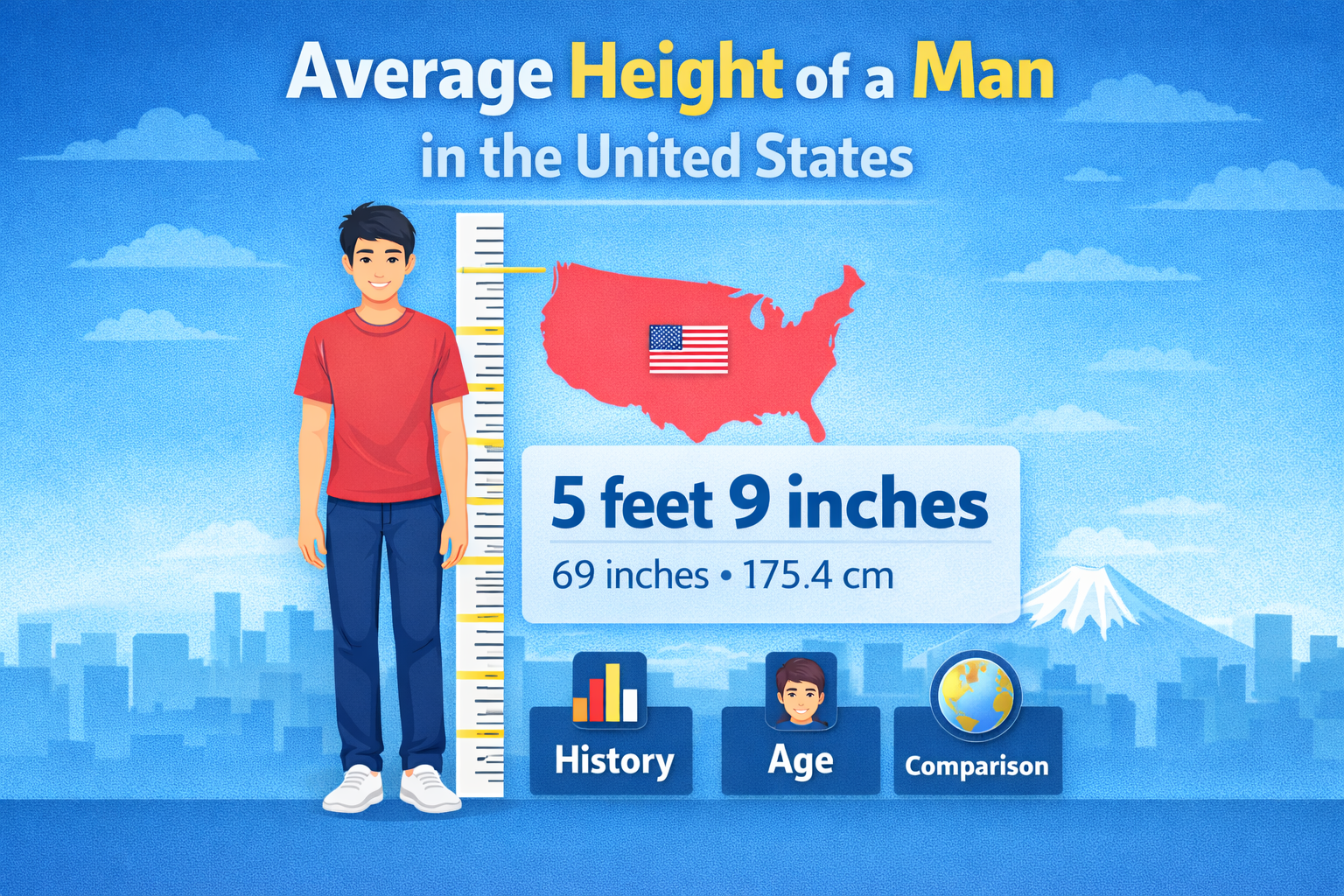
The average height of an adult man in the United States is:
5 feet 9 inches (69 inches or 175.4 centimeters)
This figure applies to men aged 20 years and older and is based on measured data collected by the Centers for Disease Control and Prevention (CDC) through the National Health and Nutrition Examination Survey (NHANES).
Average Height of a U.S. Man in Different Units
| Measurement Unit | Height |
|---|---|
| Feet & Inches | 5 ft 9 in |
| Inches | 69 in |
| Centimeters | 175.4 cm |
| Meters | 1.754 m |
When people ask about the average height of a man in the United States, this is the most widely accepted and authoritative value.
How Is the Average Height of American Men Measured?
The CDC does not rely on self-reported height, which is often inaccurate. Instead, trained professionals physically measure participants using standardized equipment.
How Height Data Is Collected
- Participants remove shoes
- Height is measured using calibrated stadiometers
- Large sample sizes ensure national representation
- Data is updated periodically
Because of this method, CDC height statistics are considered highly reliable and scientifically accurate.
Average Height of a Man in the United States by Age Group
Height can vary slightly by age due to generational differences, posture, and natural height loss later in life.
Average Male Height by Age (U.S.)
| Age Group | Average Height |
|---|---|
| 20–29 years | 5 ft 9.2 in |
| 30–39 years | 5 ft 9.1 in |
| 40–49 years | 5 ft 9.0 in |
| 50–59 years | 5 ft 8.7 in |
| 60+ years | 5 ft 8.0 in |
Key insight:
Men tend to lose a small amount of height after age 50 due to spinal compression and changes in bone density.
Has the Average Height of Men in the United States Changed Over Time?
Yes—but growth has slowed significantly in recent decades.
Historical Average Height of American Men
| Period | Average Height |
|---|---|
| Early 1900s | ~5 ft 7 in |
| 1950s | ~5 ft 8 in |
| 1970s | ~5 ft 9 in |
| 2000s–Today | ~5 ft 9 in |
Why Height Increased
- Improved childhood nutrition
- Better healthcare and disease prevention
- Higher protein intake
Why Growth Has Plateaued
- Genetic height limits reached
- Stable nutrition and living conditions
- No major environmental shifts
Unlike some countries where male height continues to rise, the average height of a man in the United States has remained largely stable since the 1970s.
Average Height of a Man in the United States by Ethnicity
Average height varies slightly across ethnic groups due to genetic and historical factors.
Average Height by Ethnicity (U.S. Men)
| Ethnic Group | Average Height |
|---|---|
| Non-Hispanic White | ~5 ft 9.5 in |
| Non-Hispanic Black | ~5 ft 9.6 in |
| Hispanic | ~5 ft 7.3 in |
| Asian American | ~5 ft 7.0 in |
These are statistical averages, not limits—individual height varies widely within every group.
How Does the Average Height of a U.S. Man Compare Globally?
The United States ranks above the global average, but below the tallest nations.
Average Male Height by Country
| Country | Average Height |
|---|---|
| Netherlands | 6 ft 0 in (183 cm) |
| Germany | 5 ft 11 in (180 cm) |
| United Kingdom | 5 ft 10 in (178 cm) |
| United States | 5 ft 9 in (175.4 cm) |
| Japan | 5 ft 7 in (171 cm) |
| Philippines | 5 ft 4 in (163 cm) |
American men are taller than the global average, but shorter than men in Northern Europe.
Is 5 Feet 9 Inches Considered Tall?
Height perception depends on context.
Height Categories (U.S. Men)
- Short: Below 5 ft 6 in
- Average: 5 ft 7 in – 5 ft 11 in
- Tall: 6 ft and above
At 5 ft 9 in, the average American man sits comfortably in the middle range.
Average Height vs Median Height in the United States
Many people confuse these two terms.
- Average (mean): Sum of all heights ÷ number of people
- Median: The middle height value
For U.S. men, average and median heights are very close, indicating a balanced distribution without extreme skew.
Does Height Affect Health in Men?
Height alone does not determine health, but it can be associated with certain risks.
Taller Men May Have:
- Slightly higher risk of some cancers
- Lower risk of cardiovascular disease
Shorter Men May Have:
- Higher risk of heart disease
- Higher risk of metabolic disorders
However, diet, exercise, genetics, and lifestyle matter far more than height.
Average Height of Men in the United States and Sports
Height plays a role in athletic performance depending on the sport.
- Basketball players tend to be much taller than average
- Gymnasts and jockeys are usually shorter
- Football and baseball players vary widely
The average height of a man in the United States represents the general population, not elite athletes.
Height and Clothing Sizes in the United States
Clothing manufacturers often design men’s apparel around the average height.
Typical Assumptions
- Regular men’s sizes assume 5 ft 9 in – 5 ft 10 in
- Short sizes are for men under 5 ft 8 in
- Tall sizes start around 6 ft 1 in
This is why 5 ft 9 in is often used as a baseline in fashion design.
Average Height of Young Men in the United States
Young adult men (ages 18–25) average slightly taller than older generations, but the difference is small.
- Most American men reach full height by age 18–20
- Height changes after adulthood are minimal
This confirms that male height growth in the U.S. has stabilized.
Can Men Increase Their Height as Adults?
Natural height increase after adulthood is not possible.
However, men can:
- Improve posture
- Prevent height loss with strength training
- Maintain bone density with proper nutrition
Medical height-altering procedures exist but are rare and not recommended for cosmetic reasons.
Why People Search “Average Height of a Man in the United States”
This keyword is popular for:
- Health and fitness comparisons
- Dating and social curiosity
- Clothing and sizing guidance
- Academic and demographic research
- Sports and military standards
Its steady search volume makes it a high-value informational keyword.
Summary: Average Height of a Man in the United States
- Average height: 5 ft 9 in (175.4 cm)
- Based on CDC-measured data
- Stable since the 1970s
- Taller than the global average
- Influenced by genetics, nutrition, and healthcare
The average height of a man in the United States serves as a key reference point across health, fashion, research, and industry.
Frequently Asked Questions (FAQ)
What is the average height of a man in the United States?
The average height of an adult man in the U.S. is 5 feet 9 inches (175.4 cm).
Is 5’9″ tall for a man?
No. 5’9″ is considered average for American men.
Has the average height of U.S. men increased?
It increased during the 20th century but has plateaued since the 1970s.
Are American men taller than men in other countries?
American men are taller than the global average, but shorter than men in Northern Europe.
Does height affect men’s health?
Height alone does not determine health. Lifestyle and genetics are far more important.
Can men grow taller after age 18?
No. Once growth plates close, natural height increase is not possible.